Brand Review
PrettyLittleThing US Review: Sale Range, Strengths and Trade-offs
PrettyLittleThing US presents a broad women’s sale navigation and a dedicated plus-size sale page, while its own pricing notice advises shoppers to check the basis for advertised reductions.
Quick verdict
PrettyLittleThing US presents a broad women’s sale navigation and a dedicated plus-size sale page, while its own pricing notice advises shoppers to check the basis for advertised reductions.
Affiliate disclosure: This article may contain affiliate links. If you follow a link and make a purchase, the publisher may earn a commission at no extra cost to you.
PrettyLittleThing US Review: Sale Range, Strengths and Trade-offs
PrettyLittleThing US presents a broad women’s sale navigation and a dedicated plus-size sale page. Its own pricing notice advises shoppers to check how advertised reductions are presented before buying.
PrettyLittleThing US at a glance
PrettyLittleThing US describes its offer as trend-led women’s clothing and accessories alongside wardrobe staples. On its homepage, the retailer says it caters to individual style and presents its range as spanning classic and timeless pieces through contemporary and cutting-edge looks. Those are the company’s own descriptions of its positioning.
The homepage also frames elevated women’s fashion as something that should be available to all, and says its clothing is designed with the customer in mind. This gives readers a sense of the brand’s stated style ambition: a mix of trend-led pieces and staples for different occasions and personal preferences. It does not tell us how well particular items are made, how they fit, or how customers experience shopping with the retailer.
This guide uses the supplied first-party page information to describe that positioning and the sale navigation it shows. It is useful for deciding whether the visible categories and advertised offer merit a closer look. For a purchase decision, check the item listing and the retailer’s current terms directly; the available excerpts do not establish product-level or service outcomes.
Shop PrettyLittleThing US Review: Sale Range, Strengths and Trade-offs →
What the public sale pages show
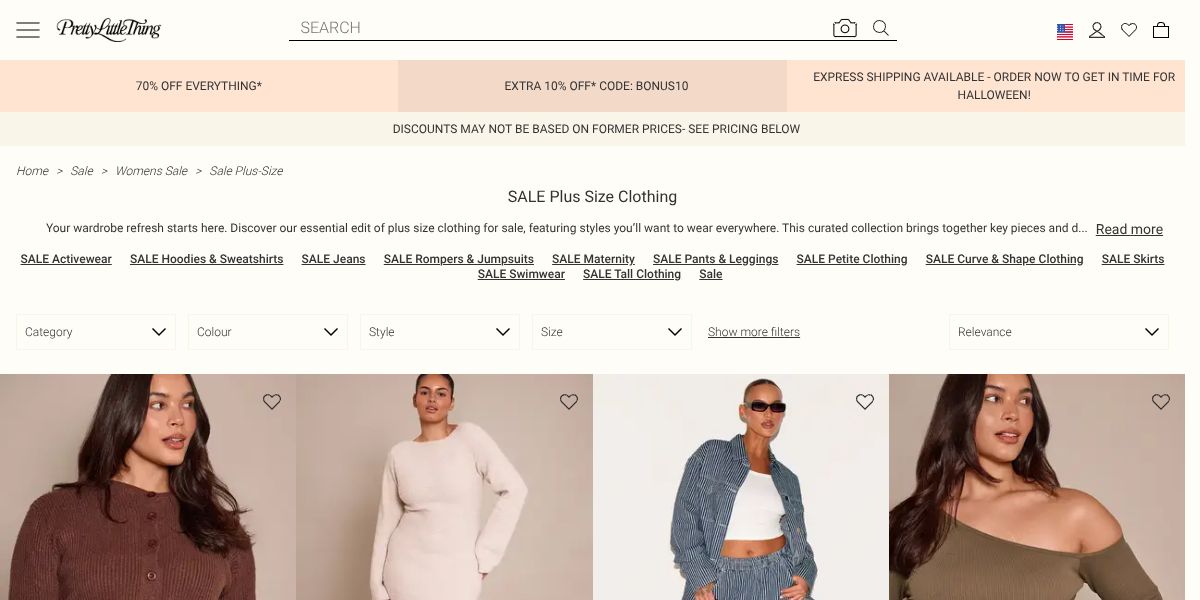
The supplied pages present a women’s sale collection and a separate plus-size sale collection. Their navigation labels offer a quick view of the kinds of departments a shopper can browse. They describe collection structure, though they do not confirm that a particular item, size, or style is in stock.
The women’s sale navigation includes these categories:
| Categories shown in the women’s sale navigation |
|---|
| Dresses · Tops · Skirts |
| Swimwear · Pants & Leggings · Plus Size Clothing |
The plus-size sale page also links to categories such as Activewear, Hoodies & Sweatshirts, Jeans, Rompers & Jumpsuits, Maternity, Petite Clothing, Curve & Shape Clothing, Skirts, Swimwear, and Tall Clothing. These labels indicate how the collection is organised on the supplied page; they are not a guarantee that each department has items available at the time you visit.
For current details, open the relevant collection and then check the item page. The supplied excerpts give category names and sale-page copy, rather than a complete catalogue or a live inventory view.
Strengths visible in the collection structure
The clearest practical strength supported by the pages is the range of categories surfaced in the sale navigation. A shopper can start from labels such as dresses, tops, skirts, swimwear, or pants and leggings, while the wider women’s sale menu also lists accessories, coats and jackets, shorts, two-piece sets, and other departments. This makes category-based browsing visible at the collection level.
The separate plus-size sale page gives readers another clear starting point. Its navigation includes several related clothing categories, from activewear and jeans to skirts and swimwear. For someone deciding where to begin, having these labels on the collection page can make it easier to move towards a relevant department without first searching through every category on the site.
That is a strength of navigation, with a specific limit: the page labels do not establish the depth of any category, the size range of an individual garment, or whether a desired item is currently available. Treat the menu as a map of the collection pages. Use the product listings to answer questions about the options currently shown.
Limitations of the available information
The supplied sale-page excerpt displays the notice “DISCOUNTS MAY NOT BE BASED ON FORMER PRICES”. That caveat matters when assessing a reduction: the banner alone does not establish the former price used for a specific item or how much a shopper saves against a comparable prior price. Read the item’s displayed pricing information and any explanatory terms before relying on a percentage reduction.
The excerpts also do not establish garment quality, fit outcomes, stock levels, delivery terms, or returns terms. The homepage describes the brand’s intended style offer, while the sale pages show collection copy and category navigation. None of that is a substitute for product details, customer-specific fit information, or the current policies that apply to an order.
If a detail affects your decision, verify it on the item or policy page before purchase. This is especially useful for confirming available sizes, materials and care information, delivery costs and timing, and the steps or conditions for returns. The supplied information gives a starting point for browsing, not enough detail to reach conclusions about those parts of the shopping experience.
How to compare PrettyLittleThing with alternatives
A useful comparison starts with what you need to buy. Choose a few relevant categories, then check whether each retailer’s current listings show options that match your preferences. The PrettyLittleThing US sale pages can serve as one reference point for categories including dresses, tops, skirts, swimwear, pants and leggings, and plus-size clothing. The category labels are a guide to where to look, not evidence that all options are available.
Next, compare item-level information on a like-for-like basis. Look at the details that matter for your choice, such as the garment description, materials, available sizes, and any fit guidance the retailer provides. If a listing leaves a question unanswered, treat that as an open question rather than assuming the item will meet your needs.
Then compare the amount you would actually pay. Check the displayed item price, whether a code applies, any delivery charge, and the final checkout total. Read each retailer’s own delivery and returns terms before comparing convenience or costs. These checks give you a more concrete basis for comparing options than a broad sale label or percentage alone.
This method does not require assumptions about named alternatives. Apply the same criteria to each option you are considering, and use current listings and policies to assess the details that affect your purchase.
Shop PrettyLittleThing US Review: Sale Range, Strengths and Trade-offs →
Promotions and sale-price checks
The supplied plus-size sale-page excerpt displays “70% OFF EVERYTHING” alongside “EXTRA 20% OFF” and code “BONUS20”. The homepage excerpt also shows a 70% off banner. These are page details in the supplied material; promotions can change, so check the relevant sale collection for the offer shown when you shop.
The sale-page notice says discounts may not be based on former prices. As a result, the percentage displayed on a banner is not, on its own, enough to establish an item’s former-price basis or the amount saved. Review the price shown on the specific listing and any pricing information presented with it.
If you plan to use a code, check its displayed terms and confirm at checkout that it applies to the item in your basket. The supplied student discount information page is another place to check for applicable details. The supplied excerpt shows the page heading, but it does not establish eligibility requirements or a discount amount. Use the current page and checkout total to verify what applies to you.
A practical decision guide
AI-generated generic editorial illustration — not a retailer product photo and does not depict the reviewed product or service. Give readers a simple visual sequence for choosing among the evidenced sale categories and checking the promotion and former-price caveat.
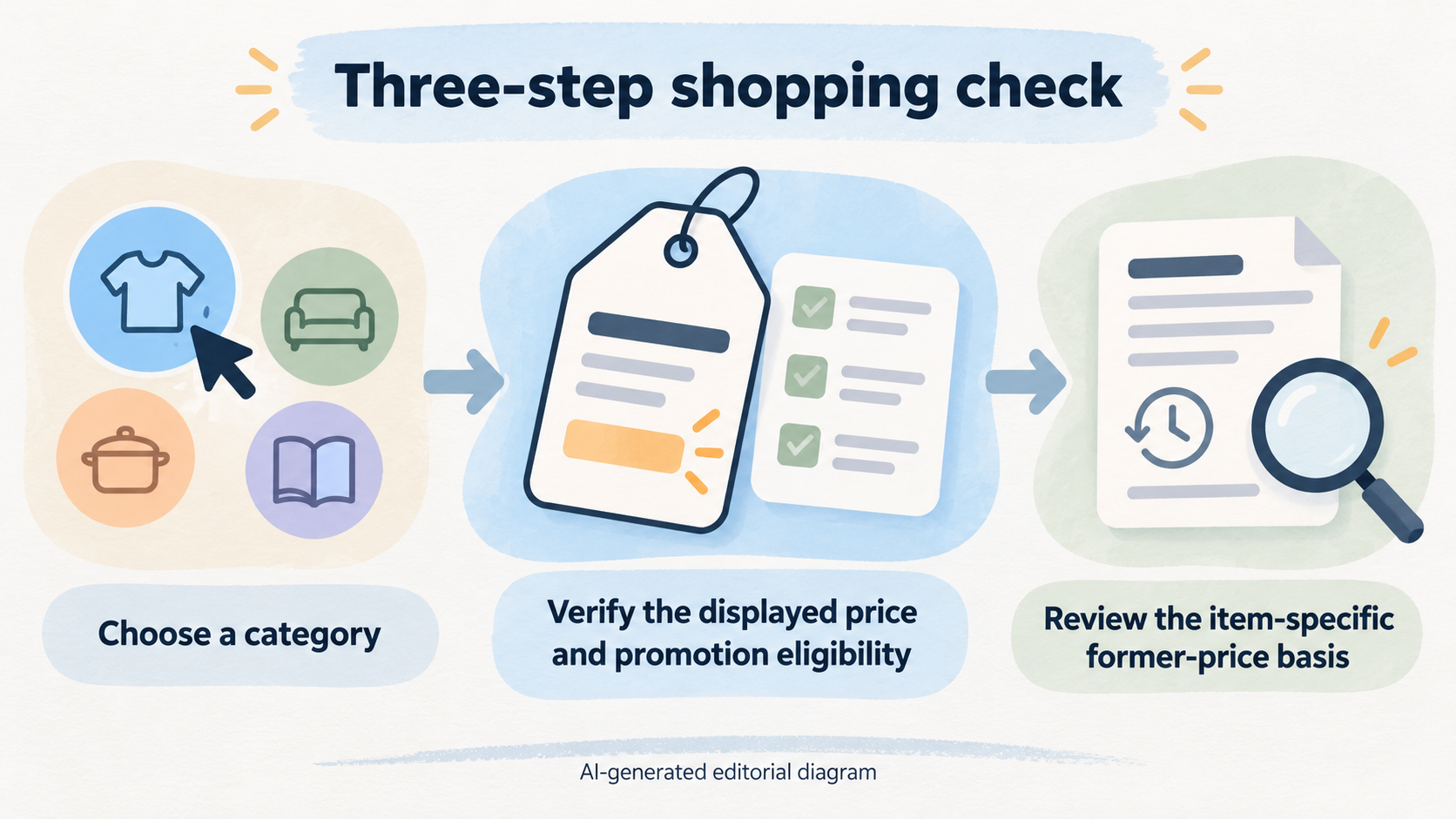
Use these checks to decide whether the visible collection is worth exploring further:
- Choose a category. Start with a department that matches what you are looking for. The women’s sale navigation lists categories such as dresses, tops, skirts, swimwear, and pants and leggings. A separate plus-size sale collection is also presented. Use the women’s sale and plus-size sale pages to see their current listings.
- Check the item and offer. Review the details shown for the particular product, including the displayed price and any available size or fit information. If a promotion or code is advertised, check its terms and whether it applies to that item. The supplied banner is not proof that every product qualifies.
- Review price context and policies. The sale-page disclaimer says reductions may not be based on former prices. Read the item’s pricing information, then check the current delivery and returns terms if they affect your decision. Use the final checkout total when comparing cost.
A dedicated plus-size sale collection and a broad category menu may make the site relevant to explore if those departments match your needs. Whether a particular item works for you depends on the information available for that item and your own requirements. Verify fit, quality-related details, price, and policies individually rather than relying on the brand description or sale banner to answer them.
Frequently Asked Questions
How does PrettyLittleThing US describe its fashion offer?
The retailer describes its offer as trend-led women’s clothing and accessories alongside wardrobe staples. Its homepage says the range spans classic and timeless styles through contemporary and cutting-edge looks, and presents the brand as catering to individual style. These are the retailer’s own descriptions; the supplied information does not independently establish product quality or customer experience.
Does the supplied evidence show a plus-size sale collection?
Yes. The supplied material includes a separate women’s sale plus-size collection page, with navigation labels for related departments such as activewear, jeans, skirts, and swimwear. That confirms the page is presented as a plus-size sale collection; it does not confirm that specific products or sizes are currently available.
Can shoppers assume an advertised discount is based on a former price?
No. The sale-page notice says discounts may not be based on former prices. Check the pricing information shown for the item and verify the final price and any code at checkout before deciding what a reduction means for your purchase.
Editorial information: About our editorial team · Read our editorial policy · Read our affiliate disclosure.
Shop PrettyLittleThing US Review: Sale Range, Strengths and Trade-offs →